Author: Bill Cork
Husband|Father|Grandfather|Catholic|Patriot
Live Update from Neshoba County Fair 2026
The Wall Cannot Withstand Freedom
Notes from the Brandenburg Gate, on the eve of the 39th anniversary of the speech that told a young Marine what he had signed up for.
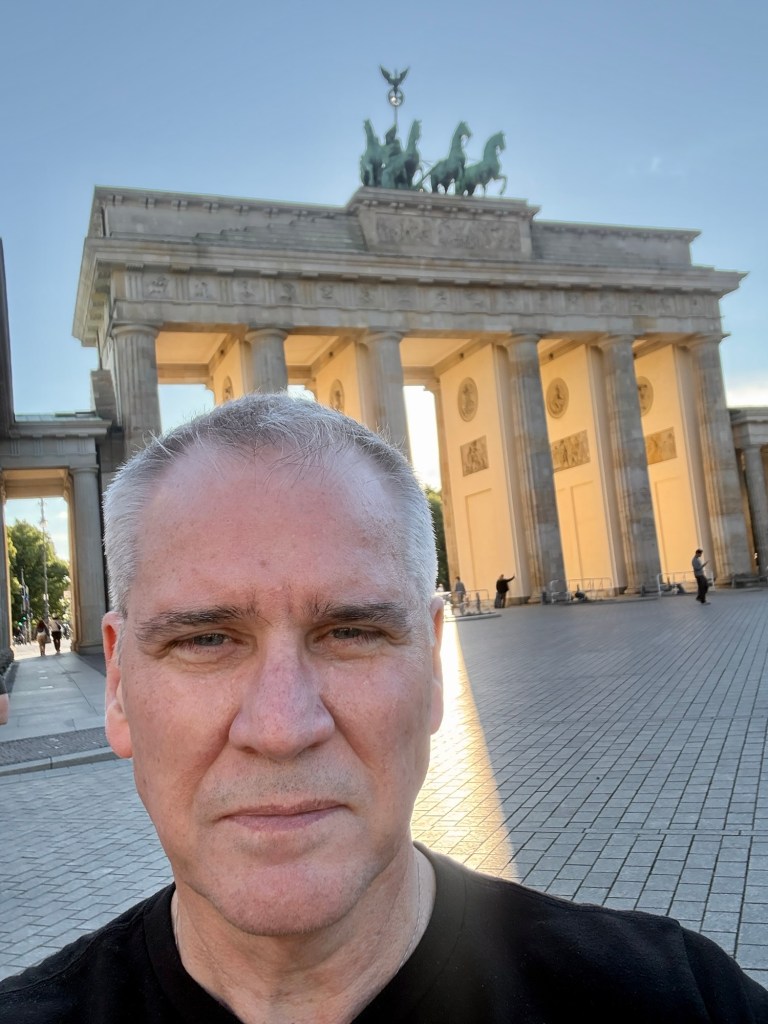
I stood at the Brandenburg Gate this evening, in the last gold light of a long Berlin summer day, and I walked straight through it. Past the columns, under the quadriga and her four bronze horses, from one side to the other, without a guard tower watching me and without a wall telling me where the free world ended. I want you to sit with that for a second, because I did. Thirty-nine years ago tomorrow, the most powerful man on earth stood on the western side of this gate and could not have done what I just did. The gate was sealed. A wall ran in front of it. The horses on top faced east into a city that was not free.
His name was Ronald Reagan, and on June 12, 1987, standing right here, he gave a speech that I watched from a long way away, in uniform, and that has shaped every working day of my life since.
Let me tell you where I was, because where I was is the whole point.
In January 1987 I had quit university and shipped to Marine Corps boot camp. By that June I was a freshly minted Marine going through military police school at Lackland Air Force Base in San Antonio, Texas. I was young, my hair was gone, my world had shrunk to formations and inspections and classes, and somewhere in the middle of all that, the President of the United States stood in front of the Berlin Wall and explained, to a kid in Texas wearing his country’s uniform for the first time, exactly what that uniform was for.
You have to understand what it is to hear that speech as a brand new Marine. I had already made my decision. I had already raised my right hand and sworn the oath, already given the Corps my hair and my sleep and my civilian assumptions. What I did not fully have yet was the why, at least not in words. Boot camp gives you discipline and pride and brotherhood, but it is not in the business of geopolitical philosophy. Then Reagan stood at the Brandenburg Gate and handed me the why, and I have never given it back.
“We come to Berlin, we American Presidents,” he said, “because it’s our duty to speak in this place of freedom.” Duty. That word meant something different to me in June than it had in December. In December it was an idea. By June it was a rack, a rifle, a schedule, and a chain of command. And here was the Commander in Chief, my Commander in Chief now, using my new word, telling the world that America shows up at the wall because showing up is what we owe.
Then he described what stood at his back, and he did not soften it. “Behind me stands a wall that encircles the free sectors of this city,” he said, “part of a vast system of barriers that divides the entire continent of Europe.” Barbed wire. Concrete. Dog runs. Guard towers. He said every man standing before the Brandenburg Gate was “a Berliner, forced to look upon a scar.” A scar. Not a border. Not a policy disagreement between two systems. A wound, cut through living families by a government that believed it had the right to do the cutting.
And then the line I have carried for 39 years. “As long as this gate is closed,” he said, “as long as this scar of a wall is permitted to stand, it is not the German question alone that remains open, but the question of freedom for all mankind.”
The question of freedom for all mankind. Sitting in San Antonio, 20 years old, government haircut, I understood for the first time that I was now part of the answer. Not a spectator to the question. Part of the answer. There are not many moments in a life when a man can feel the purpose of his work arrive all at once, complete, like a key turning. That was mine. I had joined the Marine Corps on instinct, on patriotism, on a young man’s hunger to be part of something larger than a lecture hall. Reagan gave the instinct its full name. Every Marine standing a post anywhere in the world was standing it, ultimately, against that wall and everything that wall meant. The speech did not recruit me. The speech told me what I had already been recruited for.
People remember the famous line, and they should, but I think they forget that most of that speech was an argument, and the argument was about prosperity. Reagan stood in a city that had been rubble in 1945 and reminded the world what freedom had grown back. The Marshall Plan. The Wirtschaftswunder, the German economic miracle. He praised the leaders who understood, in his words, “the practical importance of liberty,” and then he drew the line that I have spent my entire post-Marine career proving true. “Just as truth can flourish only when the journalist is given freedom of speech,” he said, “so prosperity can come about only when the farmer and businessman enjoy economic freedom.” The Germans reduced tariffs, expanded free trade, lowered taxes, and from 1950 to 1960 the standard of living in West Berlin doubled. Doubled. On one side of one wall.
Then he turned to the other side of that wall. He quoted Khrushchev’s old boast, “We will bury you,” and let four decades of evidence answer it. “In the West today,” he said, “we see a free world that has achieved a level of prosperity and well-being unprecedented in all human history. In the Communist world, we see failure, technological backwardness, declining standards of health.” And then the sentence that ought to be carved over the door of every economics department in America: “Even today, the Soviet Union still cannot feed itself.”
He gathered all of it into one verdict, and he did not hedge it the way powerful men usually hedge. “Freedom leads to prosperity. Freedom replaces the ancient hatreds among the nations with comity and peace. Freedom is the victor.”
Freedom is the victor. I believed him in a classroom at Lackland in 1987. I believe him at the foot of this gate tonight.
And then, of course, he turned the whole argument into a single demand and aimed it at one man. “General Secretary Gorbachev, if you seek peace, if you seek prosperity for the Soviet Union and Eastern Europe, if you seek liberalization: Come here to this gate. Mr. Gorbachev, open this gate. Mr. Gorbachev, tear down this wall!”
His own senior staff had fought to cut that line. They called it extreme. Unpresidential. Too provocative for the moment. Reagan kept it. And the unpresidential line, the reckless line, the line the careful men wanted struck from the draft, is the only line history bothered to remember, because it was the only line that was entirely true. That was a lesson too, and the Marine Corps was teaching me the same one in a different dialect that very summer: the cautious people are not always wrong, but they are reliably absent at the exact moment courage is required.
Twenty-nine months later the wall came down. I was still in uniform when it happened. I will not pretend I tore it down. Millions of brave Germans and Poles and Czechs and Hungarians did that, and a pope, and a president. But I wore my country’s uniform during the years the free world held the line, and I am as proud of that as I am of nearly anything in my life. America did not stumble into winning the Cold War. She stood guard for it, paid for it, believed for it, across nine presidencies and two generations of young men and women who raised their right hands the way I did. The wall fell because free people refused, decade after decade, to accept that it was permanent. That is not luck. That is character, and it was my country’s character, and I got to be one small stitch in that flag.
When I left the Corps I went looking for the other half of Reagan’s argument. He had said freedom needs defending, and I had done some of that. He had also said freedom leads to prosperity, and I wanted to spend the rest of my life proving it. So I went into economic development, which is a bloodless name for work I find almost romantic. My job, then and now and here in Mississippi where I do it today, is to take Reagan’s sentence off the page and make it real in a particular place. One factory at a time. One plant, one capital investment, one paycheck that did not exist last year and exists now because a free company chose to risk free money in a free state. Speed, risk, money, in a country where all three are still allowed. Every ribbon cutting I have ever stood at is a small, local, unglamorous proof of what he said at this gate: prosperity comes when the farmer and the businessman are free, and it comes no other way, and it has never once in human history come from the men with the plans and the walls.
So you can understand why, walking through the gate tonight, I was not only nostalgic. I was watchful. The Marine Corps trains you to stand a post, and some posts you never really come off.
Reagan understood something we are now at risk of forgetting, and he said it near the end of the speech, in a passage that never makes the highlight reels. He was explaining why the East produced misery while the West produced abundance, and he did not blame bad luck or bad harvests. He said this: “The totalitarian world produces backwardness because it does such violence to the spirit, thwarting the human impulse to create, to enjoy, to worship.”
Violence to the spirit. That is the diagnosis, and it is the right one. The wall was never really about concrete. The concrete was downstream of an idea, and the idea was that a person’s mind, speech, worship, and labor belong by right to the collective, to be arranged by the people who run it. Once you believe that, the wall is just engineering. You will always end up building one in some form, because you cannot let people freely leave a place they are not free to disagree with.
I am old enough now to say plainly what I see, and what I see is that the idea did not die in 1989. It is patient. It changes vocabulary. In its hard form it still runs prisons and starves provinces abroad, and we should not let the tidy textbook ending of the Cold War fool us about that. But in the comfortable West, in the very countries the wall was built to keep people from reaching, the same impulse has learned softer manners. It wears our clothes now. It speaks our language. It tells us it is being kind.
I mean the part of our own culture that has decided, again, that there are things you may not say. That writes speech codes and calls them safety. That asks Americans to affirm beliefs they do not hold as the price of a job, a degree, or a promotion, and calls the affirming inclusion. That has revived the oldest, most exhausted idea in human history, the idea that a person is mainly a specimen of a category, to be sorted and weighted by group rather than judged as himself, and has had the nerve to market it as progress. I have watched institutions I respect install loyalty oaths and rename them training. I have watched young Americans be taught that disagreement is a form of harm, which is precisely the lesson a wall exists to teach. And I have watched the economic cousin of all this, the eternal socialist conviction that the free choices of millions of ordinary people ought to be overruled by a plan, come back into fashion among people who have never missed a meal because of it.
I will not insult the people who actually lived behind this wall by pretending my country’s campus commissars are the Stasi. They are not. But Reagan was not warning us about the Stasi. He was warning us about the idea that produces Stasis, the one that does violence to the spirit, and that idea does not need guard towers to do damage. It only needs enough comfortable people to decide that freedom is dangerous and someone responsible ought to manage it on everyone’s behalf. Speech codes are that idea applied to the conscience. Socialism is that idea applied to the economy. Identity politics is that idea applied to the soul. They are cousins, and the family resemblance is a fundamental distrust of free people.
Reagan saw the cousins coming. The most underquoted moment of the entire speech is the very last thing he said, almost as an aside, about the demonstrators who had turned out against his visit. He wondered whether they had ever asked themselves that “if they should have the kind of government they apparently seek, no one would ever be able to do what they’re doing again.” Read that twice. He stood in front of the most photographed symbol of tyranny on earth, and the parting thought he chose was a defense of the right to protest him. He understood that a free society which cannot tolerate its own critics has already started mixing the concrete, whatever it decides to name the project.
Near the end, Reagan described words he had seen spray-painted on the wall itself, in his words “perhaps by a young Berliner.” The words were: “This wall will fall. Beliefs become reality.” And he answered that anonymous kid in front of the whole world. “Yes,” he said, “across Europe, this wall will fall, for it cannot withstand faith; it cannot withstand truth. The wall cannot withstand freedom.”
He was right, and faster than anyone dared hope. But read that spray paint again, because it cuts both ways. Beliefs become reality. Free people who believe in their freedom will pull down a wall with their bare hands, and the world watched them do it. And free people who are taught, patiently, year after year, that their freedom is a hazard to be managed will eventually agree to be walled in, and they will help pour the foundation, and they will thank the builders.
I walked through the gate tonight as a free man. A Marine, because there is no such thing as a former one. A grandfather six times over. An American who got to spend his youth standing guard over freedom and the rest of his life building what freedom makes possible. I walked through a gate that was sealed shut when I first heard its name in a classroom in San Antonio, wearing the uniform of the country that kept faith until it opened. None of that was inevitable. None of it is permanent. Freedom is not a monument you visit. It is a post you stand. In your country, in your institutions, in your own mouth when you decline to say the thing you do not believe.
The horses on top of the gate face a city that is whole now. They used to face a wall. I stood under them in the last of the light and thought about a 20-year-old military policeman in Texas, fresh from the drill field, hearing his Commander in Chief explain what his oath was for. Thirty-nine years later, the old MP reported to the gate in person. The post was secure. The gate was open. And the flag I served still stands for the thing Reagan said at this spot, the thing I have spent my whole life defending and building in equal measure.
Freedom is the victor. Semper Fidelis.
Speech to Mississippi’s Career Coaches at Catalyst 2026
Here is a long form speech about the importance of introducing our young people to careers they might not have otherwise contemplated and the importance of Mississippi’s Career Coaches in that process. It is an important discussion of the intersection Mississippi’s rapid industrial growth and the workforce of the future. The full text of the speech is here. Notes for the talk are here.

Babel or Pentecost? A Lay Catholic’s Reflection on Pope Leo XIV’s New Encyclical
Pope Leo XIV released his first major encyclical on May 25, the day after Pentecost. Titled Magnifica Humanitas, it takes up the dignity of the human person in this age of artificial intelligence. You can read the full text here on the Vatican website.
I read it prayerfully and want to share some thoughts as a Catholic layman. I have spent my career in economic development in Mississippi, and I use these tools every day for work.
Let me say plainly at the outset that I receive the Holy Father’s teaching with filial obedience. I admire the seriousness and pastoral depth of the document. I agree with much of it. The encyclical is right that technological power has shifted from governments to private companies whose resources rival those of many nation-states. It is right that the supply chains behind our devices include hidden labor and real human suffering. It is right that the displacement of workers must be met with practical justice, not platitudes. On all of this I follow the Holy Father with full assent.
Where I want to offer a complementary angle is on the dominant biblical image the encyclical uses. The Holy Father reaches for Babel. I believe Pentecost offers an equally fitting figure, at least at the level of the ordinary user, and I want to explain why.
The Babel Framing
Recall the story from Genesis. The men of Shinar said to one another, “Come, let us build ourselves a city, and a tower with its top in the heavens, and let us make a name for ourselves” (Gen 11:4). Their sin was not the building. It was the desire to make a name apart from God and the choice of one language and one technology as the instrument of that self-making. God scattered them and confused the tongues.
Pope Leo XIV uses this scene to describe what he calls the Babel syndrome of our age. He warns of a single language, a single technology and a single direction supported by a uniformity that chooses homogenization over communion. He worries that artificial intelligence and the digital revolution tempt us toward a future that excludes God and reduces the human person to data.
These warnings are serious and necessary. There is real concentration of power in the technology industry. There is homogenization at the level of infrastructure. There is a temptation to reduce persons to profiles, clicks and metrics.
What the User Actually Experiences
But here is where my daily experience as a user pulls gently against the framing. When I open one of these tools at a desk in rural Mississippi or anywhere else, what I encounter is not the Tower of Babel. It feels closer to its inverse.
Artificial intelligence answers on demand in the language of the questioner. It does not condescend on the basis of education or class. It does not refuse the inquiry of the poor man or flatter the rich. It will explain the Catechism to someone who has never owned one. It will translate the Psalms for an immigrant still learning the language of his new country. It will help a dyslexic student grasp the structure of St. Thomas Aquinas even if reading the original Latin is beyond reach.
Of course none of this is perfect. The quality depends on the underlying data and the intentions of those who built the system. Yet at the user level the dominant experience is one of translation and access. It moves between human languages. It moves between technical jargon and ordinary speech. It moves between dense old documents and prose nearly anyone can understand. The effect is plural, not uniform. Many tongues, not one tongue.
The biblical scene that matches this experience is not Genesis 11. It is Acts 2.
The Pentecost Case
On the day of Pentecost the apostles were gathered in one place. The Holy Spirit descended as wind and fire. They began to speak in other tongues, and the crowd was astonished “because each one heard them speaking in his own language” (Acts 2:6). The miracle was not a new universal language. It was that each person heard the Gospel in their native tongue.
Pentecost inverts Babel. Babel confused the tongues to scatter the proud. Pentecost multiplied the tongues to gather the humble. St. Gregory Nazianzen, preaching on Pentecost in the fourth century, made exactly this point. The dividing of tongues at Babel was a punishment because the unity sought was evil-minded. At Pentecost it was praiseworthy because the diversity served the building up of the Body of Christ.
I am not claiming artificial intelligence is the Holy Spirit. God forbid. The Spirit gives himself. The machine is built. The Spirit dwells in the soul. The machine processes tokens. The distance between them remains infinite. Yet when a created tool produces effects that resemble the gifts of Pentecost, crossing language barriers and widening access to knowledge, the Babel frame feels incomplete.
At the infrastructure layer real homogenization exists and deserves scrutiny. But the encyclical does not always clearly distinguish that level from the lived experience of the ordinary user.
The User as a Graced Subject
The deepest reason for this complementary reading is anthropological. Catholic teaching insists the human person is a subject, not a function. Vatican II taught that man fully discovers himself only in the sincere gift of himself. Even under pressure the soul remains free, accountable and addressed by God.
When the encyclical describes users as shaped by algorithms, exposed to manipulation and penalized by opaque systems, those warnings are accurate as far as they go. The harms are real. Yet if that becomes the dominant note it can unintentionally portray the user as essentially passive. Catholic anthropology says otherwise. The user is a baptized soul marked for the Lord and equipped by Confirmation for the discernment of spirits. He need not wait for platforms to be reformed before exercising that gift.
This shifts the response. If the user is primarily a victim the answer is only regulation and rescue. If the user is a disciple the answer also includes formation, gratitude and responsible use.
Where the Encyclical Is Exactly Right
Before going further I want to affirm the many places where I follow the Holy Father without reservation.
On work: The worker fearing obsolescence is not a Luddite. His vocation is part of his dignity. Pope Leo XIV chose his name and release date deliberately to echo Leo XIII’s Rerum Novarum. The Church remains the worker’s best friend.
On hidden labor: The suffering in cobalt mines, content moderation and data labeling is a decisive moral test.
On children: Unmediated exposure to these tools is a grave evil.
On war and autonomous weapons: Some decisions cannot be delegated to machines.
On power: The shift to transnational platforms demands new applications of subsidiarity, transparency and accountability.
What the Builders Actually Believe
From my work recruiting investment to Mississippi I have sat across the table from people building these systems. The encyclical rightly critiques transhumanist and posthumanist currents. Yet the dominant motivation I encounter is not Promethean dominance but a recognizable Enlightenment-style hope: democratizing access to information, leveling barriers between the credentialed and uncredentialed, and extending competence to those who could not otherwise afford it.
This is not Catholic but it is not evil on its own terms. The Catholic tradition has long held that knowledge and goods should not be the preserve of any class. St. Basil the Great taught that what a man holds in surplus belongs to the one who has nothing. Recognizing this self-understanding as a form of generosity, however imperfect, opens a richer evangelical conversation.
The Work of the User
If Pentecost is a fitting image then the user is not a victim awaiting rescue but a disciple awaiting his commission. His work includes these things.
First, to give thanks. Catholic life begins with gratitude. Thank God for tools our grandparents could scarcely imagine, then build the necessary levees.
Second, to use with discernment. Ask whether this leads me closer to God or away from him. Does it deepen relationships or thin them? Does it enlarge my capacity for charity, prayer, work and rest?
Third, to refuse. Reject uses that deceive, flatter the ego, avoid real thinking or substitute simulation for genuine relationship.
Fourth, to bless. Thank the developers who build well. Refuse blanket cynicism. Contribute to a better moral environment for the next generation of tools.
Fifth, to participate as a citizen. Engage parishes, unions, schools and civic groups. Subsidiarity demands a rich civic life alongside better regulation.
A Word on Style
I write this as a Catholic layman in mild disagreement with one accent of the Holy Father’s teaching but in full submission to his office and deep gratitude for his care. St. Catherine of Siena addressed Pope Gregory XI as babbo mio dolce (my sweet daddy) while urging reform. Obedience and plain speech can coexist.
Pope Francis reminded us that reality is greater than ideas. The reality of AI for ordinary users is mixed: hopeful and fearful, joyful and diminishing. The Church needs both images. Babel warns the powerful. Pentecost encourages the ordinary faithful.
Conclusion
Pope Leo XIV closes Magnifica Humanitas with the Magnificat. That is the right note. The Magnificat is itself a Pentecostal text. The same Spirit who overshadowed Mary at the Annunciation and the apostles at Pentecost is at work today.
The ordinary user, like the Virgin, can be overshadowed by that Spirit. He is invited to say his fiat: “Let it be done to me according to your word.” When that fiat is given to God rather than the machine even imperfect tools can become instruments of grace.
Receive Magnifica Humanitas with gratitude and obedience. Heed its warnings on power, labor, children and truth. But also receive the gifts of this age with proper thanks. Pray that these tools become instruments of translation rather than confusion, access rather than exclusion, and communion rather than mere connection.
Come, Holy Spirit, fill the hearts of your faithful and kindle in them the fire of your love. Send forth your Spirit and they shall be created, and you shall renew the face of the earth, even this earth of data centers, algorithms and users who are also souls.
Footnotes
1 Pope Leo XIV, Magnifica Humanitas (May 15, 2026), no. 7.
2 On the limits of artificial intelligence, see Magnifica Humanitas, no. 98.
3 Magnifica Humanitas, no. 100.
4 Magnifica Humanitas, nos. 115-117.
5 Other sources: Genesis 11:1-9; Acts 2:1-11; St. Gregory Nazianzen, Oration 41 on Pentecost; St. Basil the Great, Homily on Luke 12:18; Vatican II, Gaudium et Spes, no. 24; Pope Leo XIII, Rerum Novarum (1891); Catechism of the Catholic Church, nos. 1287, 1830-1831; Pope Francis, Evangelii Gaudium, no. 236.

