Tag: news
The Future of NASA: Vision, Bureaucracy, and the Right Stuff to Lead the Agency
By: William Cork
Introduction: A Mission Nearly Launched
When Jared Isaacman was nominated by President Trump to be the 15th Administrator of NASA, insiders and space enthusiasts alike felt the excitement. Isaacman wasn’t a career bureaucrat or a political placeholder—he was a battle-tested entrepreneur, an accomplished jet pilot, a commercial astronaut, and the architect of civilian space missions that made history. Most importantly, he brought a private-sector mindset to one of the most bloated and stagnant federal agencies in American government.
Then, just days before what many anticipated would be a smooth confirmation by the full Senate, the nomination was withdrawn. President Trump, as is absolutely his right, made a decision that aligns with his broader strategic vision for space policy and leadership at NASA. That decision deserves not only respect but appreciation. The President has consistently demonstrated boldness in challenging the status quo, prioritizing American excellence, and making leadership choices that reflect his deep instincts about what it takes to win. His administration has accomplished more to reignite American space leadership than any in recent memory, and we are confident that his next nominee will carry forward that momentum with clarity and resolve. What matters most is the national conversation this nomination sparked—about reform, purpose, and the role of NASA in securing America’s place in the future of space. In that debate, there is tremendous value—and an opportunity we cannot afford to waste.
During the nomination process, I was fortunate to meet with Jared Isaacman alongside Mississippi Governor Tate Reeves- after his Senate Committee hearing and before the scheduled full Senate vote. We met because Mississippi is home to Stennis Space Center (SSC) – a hub of rocket propulsion testing and innovation, employing nearly 5,000 people across dozens of tenants and supporting missions in commercial space, ocean science, and national defense.
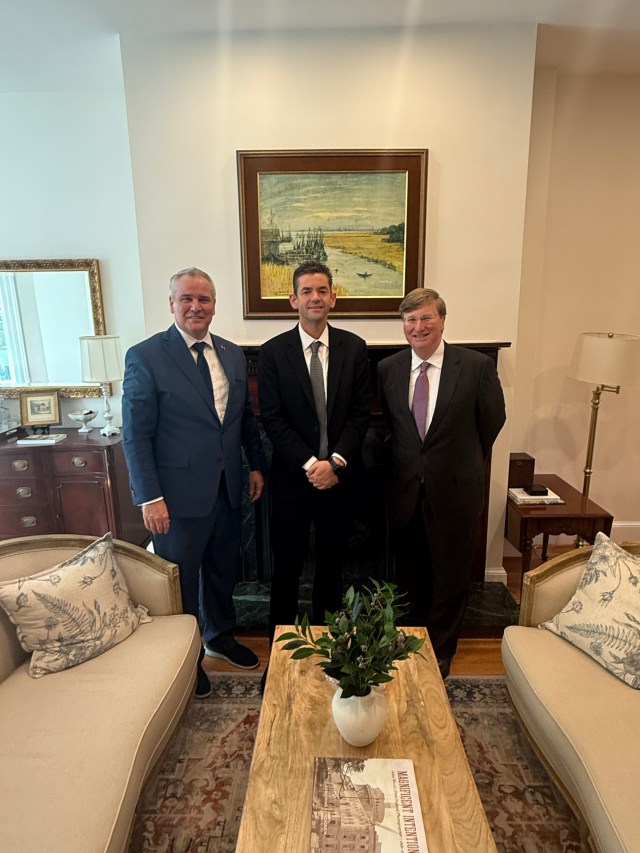
Under the leadership of several governors, the Mississippi Development Authority has invested heavily in SSC and its ecosystem. One of our key partners, the Mississippi Enterprise for Technology, works daily to sustain the center’s critical mission. Governor Reeves and I met with Isaacman to express our unequivocal support for SSC and opened the possibility to reimage what the future could be like under his leadership. We remain committed to that support for the next nominee.
Those of us who care about Stennis took Isaacman’s nomination seriously. We began building a relationship with him even before his confirmation. Through those conversations and a review of his public testimony, we came to understand the depth of his vision: a bold, no-nonsense roadmap to rebuild NASA as a streamlined, mission-driven force equipped to lead the 21st-centery space race.
In addition to my own conversations with Mr. Isaacman, two other sources are worthy of your attention. The first is a document that outlines the vision for NASA tied to the Presidential Budget (Combined Mission Fact Sheet dates 5/30/26). The other is Isaacman’s hour-long interview on the All-In Podcast (see link below), with a heavy emphasis on what he uncovered inside NASA, what he planned to do about it, and what it means for the future of American space leadership—especially in contrast to the mission priorities outlined in NASA’s Budget.
Love for NASA—But Not for Its Bureaucracy
Jared Isaacman made clear from the beginning: “I love NASA.” His respect for the agency’s mission, history, and personnel runs deep. But his experience over six months of deep engagement with NASA revealed a structural failure point that could no longer be ignored.
“NASA’s got problems. And look, that’s not unique to them—it’s systemic across every government agency. The bureaucracy is super real. No one’s going to be surprised by that.”
What troubled him most was how decision-making is hamstrung by hierarchy. He described a management culture clogged with layers of leadership, deputies to deputies, and committees that paralyze action.
“There are so many layers of management. Everybody’s got a deputy. You’ve got committees with 200 people on them. Review boards. Like—all that needs to go.”
By contrast, the Combined Mission Fact Sheet reveals a sprawling ecosystem of programs managed by multiple centers and offices, with overlapping responsibilities across lunar systems, Earth science, deep space, and STEM engagement. Nowhere does it reflect a move toward leaner governance or flattened accountability.
“Ownership needs to be pushed down to the absolute lowest level. That’s how you get velocity. That’s how you win.”
The China Challenge: This Is a Space Race
Isaacman’s vision for NASA wasn’t rooted in nostalgia—it’s driven by urgency. He warned that China is now executing the same centralized, high-efficiency playbook America used during the Manhattan Project and Apollo.
“China is doing what we did in the ‘40s and ‘60s. They place the facilities where they belong. They put the right people there. There’s no baggage. They’re moving at lightning speed.”
In contrast, NASA’s fact sheet highlights a broad and diffuse portfolio, including many Earth-centric missions and technology programs with modest timelines. While laudable in scientific merit, the document lacks a clear framework for confronting near-peer threats in lunar or cislunar space.
“We’re repurposing labs that used to be cutting-edge into places that now do ‘a lot of littles.’ Some are relevant. Most aren’t. We’re not aligned around a mission anymore.”
Budget Cuts: A Tool for Clarity, Not Chaos
Some critics seized on the Trump administration’s proposed $6 billion cut to NASA’s budget—down to the lowest level since 1961. But Isaacman defended the move.
“Overfunding leads to complacency. Bureaucracy. Slowdown. When you have to do more with less, you focus.”
The fact sheet, while dense with programs, gives no indication of prioritization based on return-on-investment or strategic differentiation. All missions appear equally weighted—whether focused on climate observations, lunar rovers, or educational outreach. This, Isaacman would argue, is exactly the problem: without budget discipline, the system grows bloated and directionless.
The Core Reform Agenda: What Isaacman Wanted to Fix
Isaacman’s vision centered on returning NASA to a focused, mission-oriented institution. His “one-pager” to President Trump outlined four pillars:
- Complete lunar obligations—especially in the face of Chinese ambitions.
- Accelerate Mars and deep-space capabilities in parallel.
- Invest seriously in nuclear electric propulsion.
- Restructure NASA to stop doing what others can do and start doing what no one else will.
The fact sheet, by contrast, reaffirms Artemis and Gateway systems as long-term programs with heavy reliance on legacy hardware and cost-sharing among a sprawling industrial base. There is no mention of nuclear propulsion as a core objective—something Isaacman calls a missed opportunity of historic scale.
“We need to stop testing light bulbs in labs and start building real systems. Like the Nautilus after WWII—we laid the keel in 1951. That’s what NASA should be doing.”
The SLS and Artemis Problem: Yesterday’s Tech at Tomorrow’s Price
While Isaacman supported completing Artemis missions already funded, he was blunt about the program’s long-term viability.
“SLS is repurposed shuttle hardware. It’s the equivalent of flying a WWII P-51 Mustang in Desert Storm because we want to keep the factory open.”
NASA’s fact sheet leads with SLS and Artemis, describing them as foundational and enduring. But Isaacman sees them as legacy projects extended for political reasons. “Use the tools we already paid for,” he argues, “but move to reusable, modern tech—especially for cislunar operations.”
Mars: The Real Mission
Isaacman affirmed that Mars—not the Moon—is the strategic and scientific priority.
“Mars is the next step. It’s not pretty. It’s not easy. But it’s our path forward. And we’ll learn things out there that will change how we see everything.”
NASA’s document lists Mars sample return as a technology objective, but it is not framed with urgency or finality. Isaacman, by contrast, believes Mars should be a continuous goal, developed in parallel—not sequenced after multi-decade lunar programs.
Science and Speed: A New Model for Discovery
Isaacman criticized the slow pace and spiraling cost of flagship science missions.
“We should launch James Webb or Hubble-type programs every year—not once a decade. Let’s try 10 $100M missions. Let three fail. We’ll still learn more than one $3B mission that takes 12 years.”
The fact sheet lists a robust science portfolio, but offers little indication of reform in pace, cost control, or failure tolerance. Isaacman proposes a more venture-style model: faster iterations, distributed bets, and reduced fear of failure.
Let Commercial Space Lead—And Let NASA Build What They Won’t
Isaacman sees the rise of SpaceX, Blue Origin, and Rocket Lab not as threats to NASA, but opportunities.
“Let SpaceX get us to orbit. Let NASA focus on what no company will touch—like in-space nuclear, or infrastructure to mine and manufacture off-Earth.”
NASA’s fact sheet mentions partnerships but keeps them on the periphery. Commercial crew and cargo are cited as examples, yet the document does not reflect a philosophical shift toward maximizing industry’s lead and letting NASA focus on frontier technologies.
Final Thoughts: The Administrator Who Isn’t and What to Say to the Next Nominee
Isaacman’s vision wasn’t about politics. It was about restoring mission discipline, rooting out inefficiency, and making NASA the tip of the spear again.
“NASA should shock the world—not sponsor rocket clubs.”
Though Isaacman won’t be Administrator, his reform blueprint remains on the table. For those who want a NASA that leads rather than lags, his plan offers a place to begin—and a mirror to measure the current direction reflected in official documents like the 2026 mission sheet.
“We can’t bet on 100 miracles to make Mars work. We need to build infrastructure—nuclear, industrial, scalable. That’s what NASA should do.”
Conclusion: America’s Space Imperative
Stennis Space Center is not just another NASA facility—it’s a national asset hiding in plain sight. With over 30,000 acres of usable space and a 125,000-acre acoustical buffer, it dwarfs every other NASA installation except Kennedy. You could fit almost the entire agency inside the Stennis footprint. And yet, its role in shaping the future of space exploration has too often been peripheral.
That needs to change.
From the very beginning, the people of Mississippi—and particularly Hancock County—have embraced the dream of interplanetary exploration. They gave up their homes and land to build Stennis. And for generations, they’ve been unwavering stewards of this mission-critical facility. Their message is simple: We still believe. We still want to lead.
That was the spirit Governor Tate Reeves conveyed directly to Jared Isaacman during our meeting. Mississippi isn’t just along for the ride—we’re ready to build, to innovate, and to partner with NASA in shaping what comes next. Whether it’s propulsion testing, commercial space integration, or Earth science innovation, nothing is off the table.
Isaacman may not have been the final nominee. But he was a candidate with vision—clear, coherent, and executable. Our hope now is that the next nominee brings the same urgency and clarity and arrives at NASA with eyes open to collaboration and ambition.
“NASA should be the place where impossible things happen,” Isaacman told us. “That’s what it was built for. That’s what it can be again.”
We agree. Mississippi is ready to help make the impossible real.
Let’s break new ground (in space) —together.
Mississippi vs. Britain: A Tale of Two Economies
By William Cork
It might come as a surprise to many—especially across the Atlantic—that Mississippi, long labeled “America’s poorest state,” now enjoys a higher per capita GDP than the United Kingdom. In a recent conversation hosted by the Institute of Economic Affairs, Douglas Carswell, President & CEO of the Mississippi Center for Public Policy and former British MP, laid out a compelling case for how Mississippi’s embrace of economic freedom is yielding results that Britain would do well to learn from.
“People in Britain will be shocked to hear that Mississippi is now more prosperous than the UK,” Carswell says. “But that’s the truth. And the reason isn’t complicated—it’s about the choices we’ve made.”
As someone deeply engaged in Mississippi’s economic development and policy planning, I found Carswell’s argument both refreshing and instructive. Mississippi has become a test case for how targeted policy changes—focused on tax reform, labor deregulation, and education innovation—can unlock growth in even the most economically disadvantaged regions. And yes, it’s working.
The first point Carswell underscores is tax reform. “We’ve passed legislation that will completely eliminate the state income tax by 2037,” he explains. “We’re moving to a flat-rate income tax, and eventually we’ll have none. That sends a clear signal to businesses and workers.”
This kind of tax clarity makes a difference. It not only makes the state more attractive for new investment, but it also allows people to keep more of what they earn. Compare that with the UK, where the tax burden is at a 70-year high. Carswell doesn’t mince words: “The UK is stuck in a 20th-century model. There’s no incentive to produce, to invest, or to innovate.”
Mississippi, by contrast, is leaning into competitiveness.
Second, Carswell praises Mississippi’s aggressive rollback of occupational licensing.
“We’ve removed a lot of unnecessary regulation that prevents people from working,” he says. “You shouldn’t need a state license to be a hair braider or a florist.”
These are reforms that go straight to the heart of opportunity creation. In Britain, the bureaucracy is often stifling—not just for entrepreneurs but for anyone trying to get ahead. Carswell’s experience in both systems makes the comparison stark.
“In the UK, you have bureaucrats and technocrats who think they know better. In Mississippi, we’re putting power back in the hands of individuals.”
Another area where Mississippi pulls ahead is energy policy. By avoiding green mandates that drive up energy costs in Europe, the state has kept energy prices low—and stable.
“We’re not hostile to renewables,” Carswell clarifies, “but we’re not going to impoverish people to signal virtue. Low energy prices mean families and businesses can thrive.”
That one point alone puts Mississippi ahead of many Western economies that have overburdened themselves with regulations in the name of environmental responsibility but have failed to deliver affordable, sustainable energy in return. Governor Reeves’ recently announced Energy Power Play initiative will elevate this idea to a point of action.
One of the most surprising elements of Mississippi’s success story is education. Despite its reputation, Mississippi is now leading the nation in early literacy gains. Carswell attributes this to a focus on phonics-based reading instruction and real accountability.
“We said, if a child can’t read at grade level by third grade, they don’t advance. That’s tough love, but it works.”
Mississippi’s education reforms don’t stop at literacy. The state is part of a growing movement in the U.S. for school choice. “Fifteen or sixteen states now have universal school choice,” Carswell notes. “Parents can take their child’s education dollars and go wherever they want—public, private, or charter.”
This is a revolution in accountability and empowerment. And again, it contrasts sharply with the UK’s centralized, bureaucratized education system.
“You want better schools? Give parents the power to walk away from the bad ones,” he says.
Carswell is clear-eyed about the causes of Britain’s decline. Despite voting for Brexit and electing a series of nominally conservative governments, the UK has drifted further into technocratic inertia.
“Britain hasn’t really had a conservative government in 28 years,” he says. “We’ve had Blairism dressed up in different colors.”
The result? Ballooning welfare rolls, housing shortages due to planning regulations, and a culture of dependency.
“The UK is a country where the state is everywhere, and the individual is nowhere,” Carswell remarks. “That’s not how you build prosperity.”
He calls for radical reform: cutting public spending, abolishing the Equality Act and Human Rights Act, and upending the planning system to free up housing supply.
“This isn’t about left or right anymore. It’s about whether we believe in the individual or the state.”
For those of us working in economic development, Carswell’s message is clear: pro-growth policies work when they empower people. Mississippi didn’t wait for Washington to give it permission to modernize. It made bold decisions at the state level—decisions that would be politically unthinkable in much of Europe. Many of Carswell’s ideas should be made manifest in Mississippi and with a supermajority of conservatives in the legislature and in all statewide offices, there is no excuse for not getting it done.
And while the UK is a country with enormous strengths—world-class institutions, a deep talent pool, and a proud industrial tradition—it is being held back by a mindset that prioritizes control over competition. Mississippi should not make the same mistakes.
“Mississippi doesn’t have London’s history, wealth, or institutions,” Carswell says. “But we’ve got something powerful: a belief in the dignity of work and the importance of economic freedom.”
That belief drives what I do in economic development here in Mississippi and it’s a belief that’s paying off.
Economic development is a choice. Mississippi chose reform, resilience, and risk. Britain chose stagnation, safety nets, and status quo.
One is rising. The other is falling behind. It’s wonderful that a Brit is reminding Mississippians that while we have work to do, we have momentum and this is our time.
Watch the whole interview here:
 Bill Cork