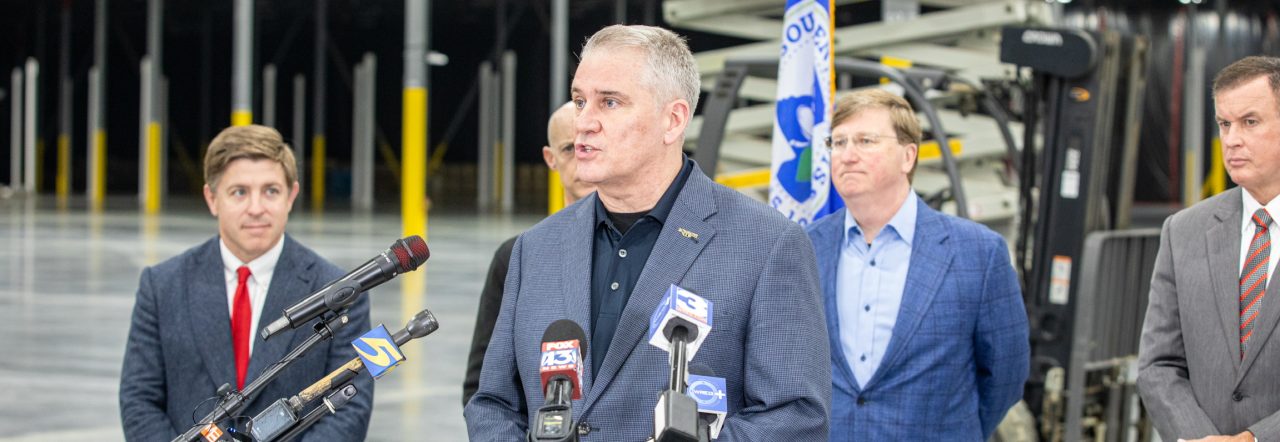
Why Mississippi Is Winning — And What It Takes to Keep It Going

By William Cork

It’s an exciting time to be doing economic development in Mississippi.

We’re not just seeing growth — we’re seeing the kind of record-breaking momentum that only happens when people get aligned, work a plan, and follow through. Since 2020, under Governor Reeves’ leadership, we’ve landed over $31 billion in new capital investment and more than 22,000 jobs. And we’ve done it with a smaller team and a smarter approach.

This isn’t about headlines or photo ops. It’s about building something real — something that lasts — for the people of Mississippi.

A few months ago, I sat down with Damon Tipton for his podcast and had a wide ranging interview. If you listen to it (it’s linked at the end of this post) you’ll learn a lot about what Mississippi is doing to position us for the future.

Let me provide a quick summary of the key points of the interview, and give you a walk through what I believe is driving our success, and what it’ll take to keep moving forward.

We Don’t Incentivize Hope — We Incentivize Performance

We’ve changed how Mississippi does business. We used to write checks up front and hope it all worked out. But if the project didn’t materialize, we were stuck trying to claw that money back from companies that were already failing.

Now, we do it differently.

With tools like the Mississippi Flexible Incentive Tax Credit, we tie performance to benefits. Companies don’t get incentives until they’ve met their commitments. Just like a contractor’s draw — you perform, you get paid. It’s conservative, it’s smart, and it protects the taxpayer.

Speed, Risk, and Money — Plus the Intangibles

When a company is evaluating where to put a factory or a data center, they’re asking three things: How fast can I move? What’s the risk to my business? What’s it going to cost?

Mississippi has learned how to answer those questions well.

But there’s a fourth element that gets overlooked: the intangibles. A lot of states can check the same boxes we do. But companies are also looking at culture, at values, at brand. They want to know: If I tie my brand to this state, what does it say about me?

We had to confront that head-on with the old state flag. Nobody could quantify how many deals we lost because of it, but we all knew it was an issue. Now, with a flag that reflects the values of our people, we’re no longer starting conversations with a disadvantage.

This Is About People

When we cut a ribbon and I see workers standing there in their uniforms — ready to go to work, with a wage that supports a family and a future — that’s why I do this job.

I’ve been in economic development for over 30 years. I’ve worked projects from the local level to the national level. Nothing compares to the run we’ve had over the last five years. And nothing compares to the reward of seeing Mississippians thrive because we landed a company in their town.

This job is about people. It always has been.

Mississippi Is Affordable — But We’re Not Cheap

Too often, people mistake affordability for being low-quality or low-wage. That’s not the case here.

We’re affordable — for both companies and workers — but we’re not racing to the bottom. The average wage for the manufacturing jobs we’ve brought in is around $60,000 a year. These are family-sustaining jobs with real upward mobility.

I don’t want us competing to be the cheapest. I want us to be competitive — on value, on speed, on workforce, and on outcomes.

Why Net Export Income Is the Whole Ballgame

One of the most important things we think about at MDA is what I call net export income.

If we’re going to grow our economy, we have to bring money into Mississippi — not just move it around within the state (which is also a good thing). That’s why we don’t typically incentivize retail or restaurants. Those businesses are important and they generate a multiplier effect, but our primary target is attracting new dollars to the state.

When Nissan builds cars here and sells them globally, that creates net export income. When the federal government funds military contracts and R&D in Mississippi, that’s money we’ve pulled in from across the country.

And when a tourist comes here and spends their dollars — we’re exporting our experience and importing their money. That’s how you grow a state economy.

The Tech Boom Is Real — and We’re Ready for It

Our recent wave of hyperscale data center announcements didn’t happen by accident. We’ve built out fiber infrastructure, we’ve got abundant power and water, and we’ve prepared sites in advance.

We’ve also invested in workforce — from construction and HVAC to cybersecurity and AI.

We’re not just chasing the leaves and ornaments of a tech ecosystem. We’re planting the roots and growing the trunk. When you get that right, the rest follows.

Immigration and Workforce: A Pragmatic, Human Approach

I served in the Marine Corps. As a military policeman at Camp Pendleton, I personally apprehended hundreds of undocumented migrants. I’ve seen firsthand what it looks like — scared families, children, people just trying to find a better life.

At the same time, I believe in law and order. We need to secure the border. We need to enforce our laws. But we also need to acknowledge the humanity behind the issue and look for common-sense solutions.

We’ve got around 42,000 working-age Mississippians not in the labor force today. We need to figure out how to re-engage them — not grow welfare, but grow opportunity.

Eliminating the Income Tax Is the Right Move

Governor Reeves has made it clear: he wants Mississippi to eliminate its personal income tax. I agree.

Taxing labor is the wrong way to grow an economy. When you tax something, you discourage it. That’s Economics 101.

States like Florida, Texas, and Tennessee have shown that you can eliminate income tax and still grow — in fact, they’re growing faster. If we want to attract high-net-worth individuals and business owners, this is a smart play.

Yes, we’ll need to be smart about the transition. But long-term, the benefits outweigh the risks.

If You Want to Win, You’ve Got to Show Up

I tell communities all over the state: you can win something — but only if you’re aligned, prepared, and committed.

Amazon in Madison County, Aluminum Dynamics in Columbus, Compass in Meridian — none of those projects happened overnight. They were years in the making. Some of them started with a water line to a piece of empty land.

The state will meet you halfway. But we can’t do it for you. If you’re fighting among yourselves or waiting for someone else to act, you’re not going to see results.

Get organized. Make a plan. Stick to it. That’s how we win.

Mississippi is on a run right now. The stars have aligned — and we’ve worked hard to make it happen. We’ve got more work ahead, but the mission hasn’t changed.

We’re here to serve. We’re here to grow. And we’re here to make this state everything we know it can be — for every worker, every community, every business.

Mississippi has momentum. This is Mississippi’s time.

Watch the full one-hour interview here where we go into these concepts in detail and much more!!

Welcome to the New Era: Treasury Secretary Scott Bessent and the Plan to Rebuild America

By William Cork

On a day that began with a tour through the West Wing, conversations with Elon Musk and David Sacks, and a detour through the White House soda machine, the All-In crew capped things off with a marathon sit-down with Treasury Secretary Scott Bessent. It was more than just another podcast episode—it was a 90-minute masterclass in how the Trump administration is trying to rewire the U.S. economy for sustainability, growth, and national security.

Scott Bessent, former macro investor and now 79th Secretary of the Treasury, is not a politician. That’s what makes this conversation so important.

“I’ve been in this building seven weeks. President Trump’s been back in the White House for eight. But we’re not here to take a victory lap. We’re here to fix what’s broken.”

This isn’t your usual D.C. doublespeak. Bessent lays out a clear, three-part plan: delever the government, deregulate the private sector, and drive a strategic reindustrialization of America.


Debt and Deficit: “We don’t have a revenue problem. We have a spending problem.”

Let’s start with the elephant in the room: the U.S. debt and deficit. Under Biden, spending ballooned to 25% of GDP, well above the 21% historical norm. Bessent puts it plainly:

“We’re going to deflate it slowly. Our goal is to get back to 3% deficit to GDP by 2028.”

The Trump administration’s goal isn’t a slash-and-burn austerity model, but a long glide path to discipline.

“Every $300 billion we cut is about 1% of GDP. You try to do that too fast, you’re landing the plane in a nosedive.”

Instead, Bessent frames it like a macro investor would: strategic deleveraging on the public side, while enabling productive releveraging in the private sector.

“We’re going to cut spending in a controlled way. At the same time, deregulate so the private sector can pick up the slack.”

The vision is a leaner federal government with fewer contractors, fewer overlapping regulations, and a smaller footprint—one that clears the runway for private growth.


Main Street vs. Wall Street: “It was driving me crazy when Kamala Harris said she was fighting for the middle class.”

Bessent is relentless on one theme: the Biden years eviscerated the American middle class. Inflation didn’t just rise—it hit people without assets the hardest.

“If you had stocks, great. But if you didn’t, the cost of everything inflated and you had no way to catch up. It was fundamentally unfair.”

He points to the ‘Everyman Index’ from Strategas that shows inflation for working families was closer to 35%, not the 22% reported in CPI.

“Used car prices. Car insurance. Rent. Groceries. If you’re in the bottom 50%, you got hammered. And people noticed.”

And that’s why Trump is running again. Bessent didn’t mince words:

“About 18 months ago, I told President Trump I wanted to get involved. Because we were going to the point of no return.”

His critique of the Democrats is both technical and philosophical:

“They spent like we were in a war. Or in a depression. We were in neither. It was cynical. Spend now, raise taxes later, trap the country in a European-style social democracy.”


Macro View: How a Soros Alum Is Rethinking the American Economy

This isn’t just political revenge—it’s deeply grounded in a macro investor’s worldview. Bessent’s resume reads like a who’s-who of Wall Street legends: trained by Jim Rogers, mentored by Stan Druckenmiller, former CIO at Soros Fund Management.

He walked through the famed 1992 trade that broke the Bank of England, describing the kind of asymmetric thinking that now guides policy:

“I realized British mortgages were floating rate. If they raised rates to protect the pound, homeowners would be bankrupted.”

“Stan said, why not bet the fund? Soros replied, ‘Why not three times that?’”

That’s not bluster—it’s a strategic worldview. What’s unsustainable will break. Policy should anticipate that, not react.


Deregulation: “Why do small banks have to hold the same capital as JPMorgan?”

One of the sharpest lines in the entire interview came when Bessent addressed the regulatory overhang:

“Small banks are 70% of ag loans and 40% of small business loans. They’ve been suffocated by overregulation.”

The plan? Undo the financial corset:

  • Reassess Basel frameworks
  • Repeal duplicative capital requirements
  • End one-size-fits-all rules for small banks

He even suggested a technical fix to the Supplementary Leverage Ratio that could shave 30–70 basis points off Treasury yields.

“Every basis point we save is a billion dollars per year.”


Trade and Tariffs: “We’re reordering the international trading system.”

The second pillar of the strategy is reindustrialization. This means:

  • Targeted tariffs to shift supply chains
  • Low and predictable tax rates
  • Radical deregulation
  • Cheap, abundant energy

“We can’t crush labor like China. So we’ve got to crush energy prices.”

It’s a nationalist economic strategy—but designed for resilience, not isolation.

“The goal isn’t protectionism. It’s fairness. Predictability. And getting the U.S. back into the game.”


The Sovereign Wealth Fund: “We’re going to mobilize the asset side of the balance sheet.”

Perhaps the most transformational idea? A U.S. sovereign wealth fund. Bessent, alongside Doug Burgum and Howard Lutnick, is leading the charge.

“Why does Social Security sit in Treasuries? Why can’t it participate in the American economy?”

He cites the models in Alaska, North Dakota, even Australia:

“We want to create assets for the American people—not just debt.”

The fund will be built on federal assets: energy leases, urban land, and future privatizations. The goal is to beat the 10-year Treasury rate and offer every citizen a stake in national prosperity.

“The idea is compounding. Compounding security. Compounding hope.”


The Culture of Reform: “It’s the Department of Government Efficiency, not Government Elimination.”

Bessent was candid about the institutional resistance in Washington:

“Within a 10-mile radius, 25% of U.S. GDP pulsates through here. Everyone wants to skim a little.”

But he’s not on a warpath against federal workers:

“The people here are great. I’d hire many of them in my private firm. It’s the system that’s broken.”

From IRS reform to AI-driven tax compliance to slashing contractor grift, this is a modernization agenda—not a demolition job.

“We’re not trying to cut government. We’re trying to make it smarter. More responsive. More accountable.”


On President Trump: “He regards himself as the Mayor of America.”

Bessent had nothing but praise for Trump’s instincts, memory, and humanity:

“He listens. He takes it all in. And he cares about everyone—whether you’re Elon Musk or the guy cutting the Rose Garden.”

And the tone of this administration?

“This isn’t about ideology. It’s about effectiveness.”


Final Word: Affordability, Growth, and a Return to Common Sense

From supply chain czars to energy reform to housing deregulation, Bessent made one thing clear: the affordability crisis is real—and solvable.

“Inflation is quiet. But affordability got away from people. We’re going to fix that.”

This is the plan. It’s detailed. It’s bold. And it’s rooted in market logic, not bureaucratic inertia.

America is at a crossroads. Scott Bessent is making sure we take the path that leads not just to recovery—but to renewal.

Here’s the full episode and worth a watch!